Châtillon-sur-Marne – History, Landscapes, and the Identity of Champagne
30
Sep 2026
Condividi su:
Châtillon-sur-Marne is a municipality in the Marne department, in the Grand Est region, located on a natural rise that directly overlooks the Vallée de la Marne. Its elevated position, situated on the Rive droite of the river, has over the centuries shaped the site’s strategic role, the agricultural organization of the territory, and its symbolic function within historic Champagne. Today the village is known for its medieval heritage, for the large statue dedicated to Pope Urban II, and for the surrounding vineyard landscape, an element that continues to define the visual, cultural, and productive character of the area.
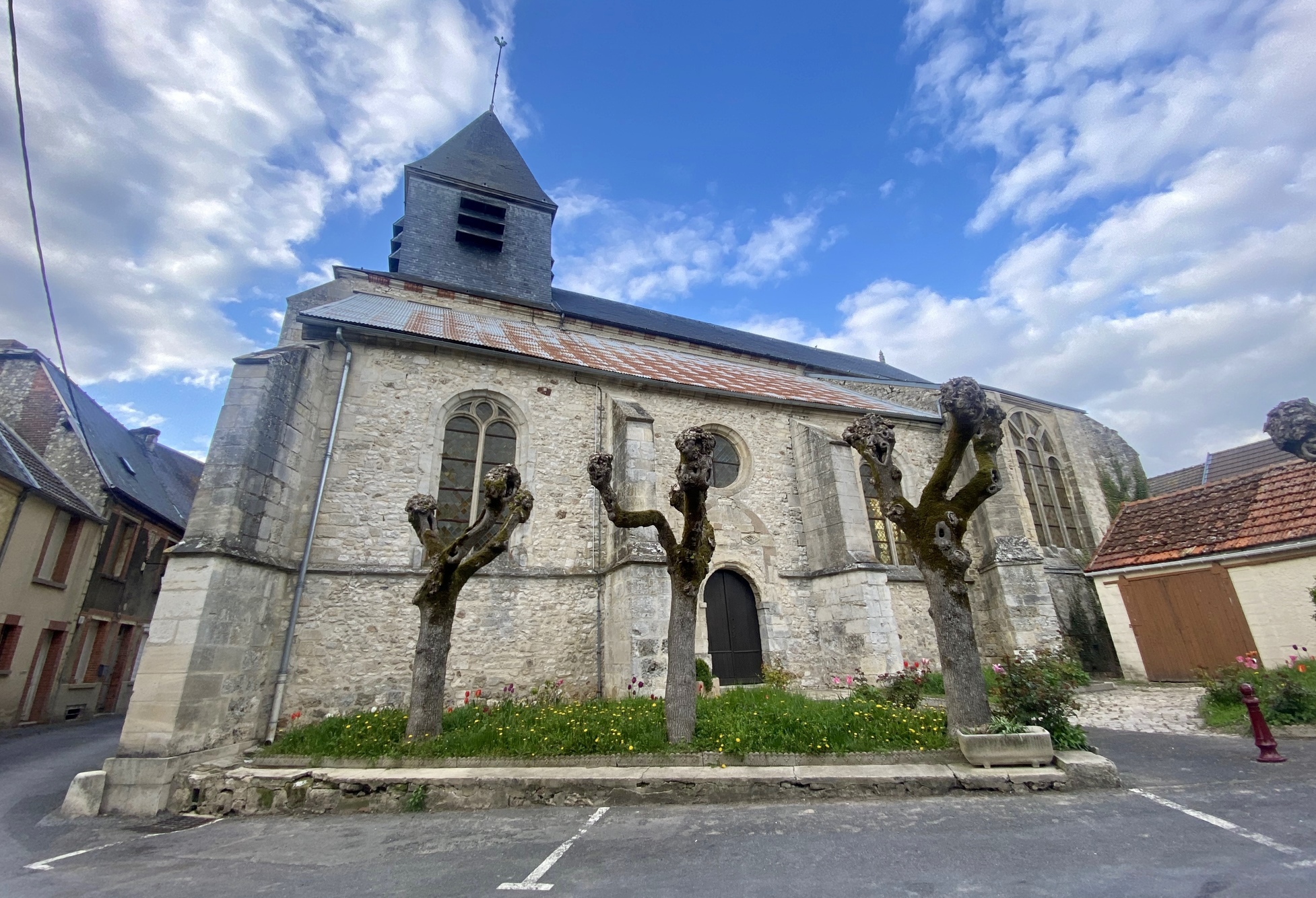
"Église Notre-Dame di Châtillon-sur-Marne – XII sec."
Historical origins and control of the valley Historical sources record for Châtillon-sur-Marne the ancient name Castello-Super-Matronam, which refers to a settlement located “above the Marne.” This designation reflects a precise strategic choice: the elevated ground allowed direct visual control over the valley and the fluvial communication routes, which in Roman times were essential both for the transport of goods and for military movements.
The existence of a Roman or Late Antique fortification is plausible, as the site lay in a logistically sensitive sector, along the territorial corridor linking Durocortorum Remorum (present-day Reims) to the Seine basin. During the Middle Ages, remains of the castrum were still visible, evidence of settlement continuity and the progressive reuse of pre-existing structures.
With the decline of its military function, Châtillon-sur-Marne gradually evolved into an agricultural center. The landform, the favorable exposure of the slopes, and the quality of the soils encouraged vine cultivation, which became the area’s main activity. Already in the early modern period the village was recognized as a wine-producing locality, and today it fully falls within the Champagne AOC perimeter, with a landscape durably shaped by viticulture.
Pope Urban II, a foundational figure for the village’s identity The bond between Châtillon-sur-Marne and Pope Urban II represents one of the strongest identity markers of the municipality. Historical sources place the pontiff’s birth between 1040 and 1042, while local tradition indicates 26 April 1042. The recorded date of death is 29 July 1099.
Before his election to the papal throne, Urban II was a monk and abbot of Cluny, one of the most influential religious centers of the 11th century. In 1088 he was elected pope, and his pontificate remains indissolubly linked to the proclamation of the First Crusade, announced in 1095 during the Council of Clermont. For the village, his figure is not merely a historical reference, but a true identity pillar that continues to shape local collective memory.
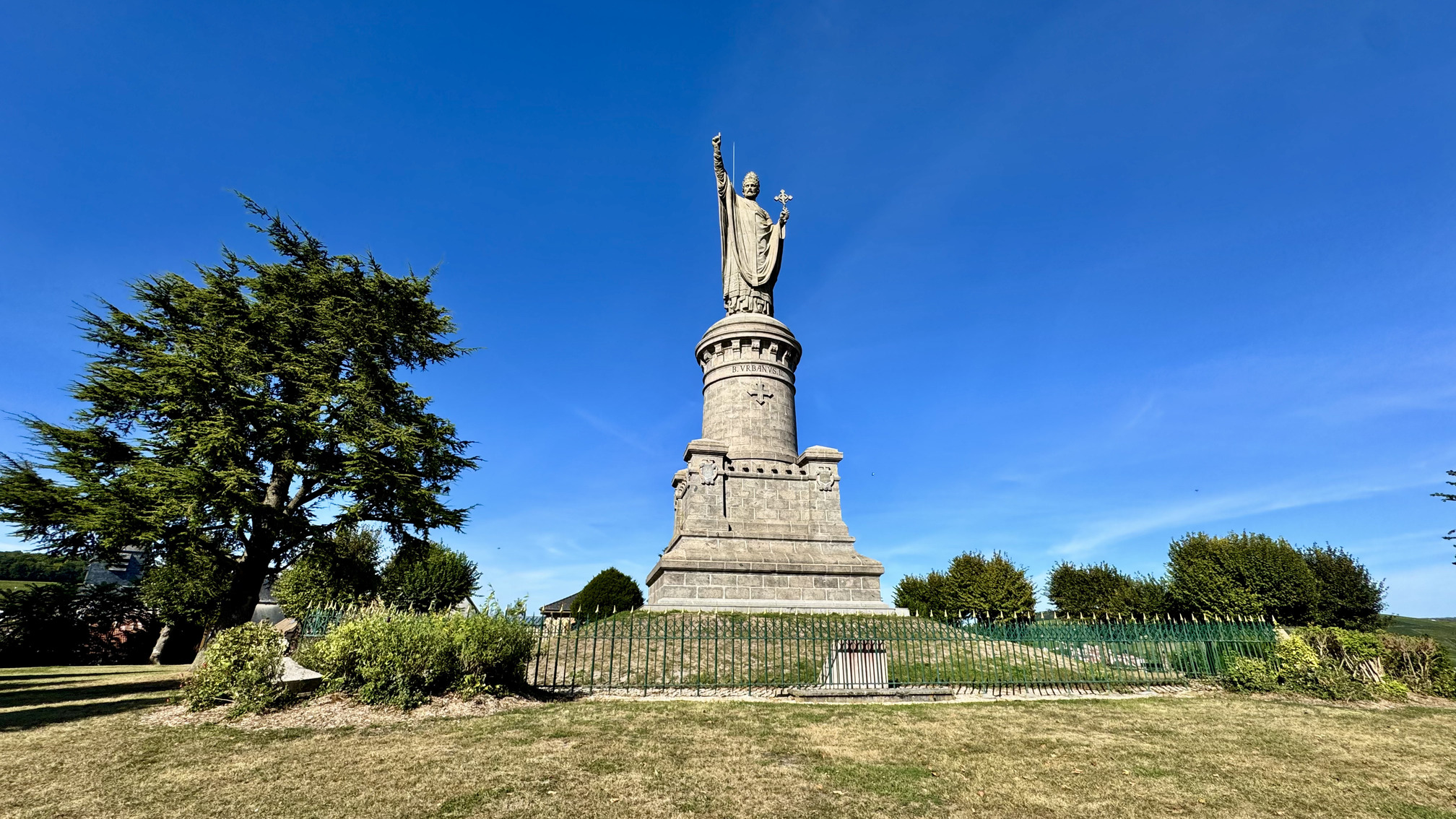
The monumental statue and the panoramic viewpoint To honor the pontiff, in 1887 Châtillon-sur-Marne commissioned a monumental statue that today represents the village’s most recognizable visual symbol. The work, officially inaugurated on 19 July 1887 by the President of the French Republic Sadi Carnot, reaches a total height of 33 meters and consists of a massive base surmounted by the figure of the pope with his right arm raised, a gesture recalling the traditional iconography of Urban II addressing the faithful.
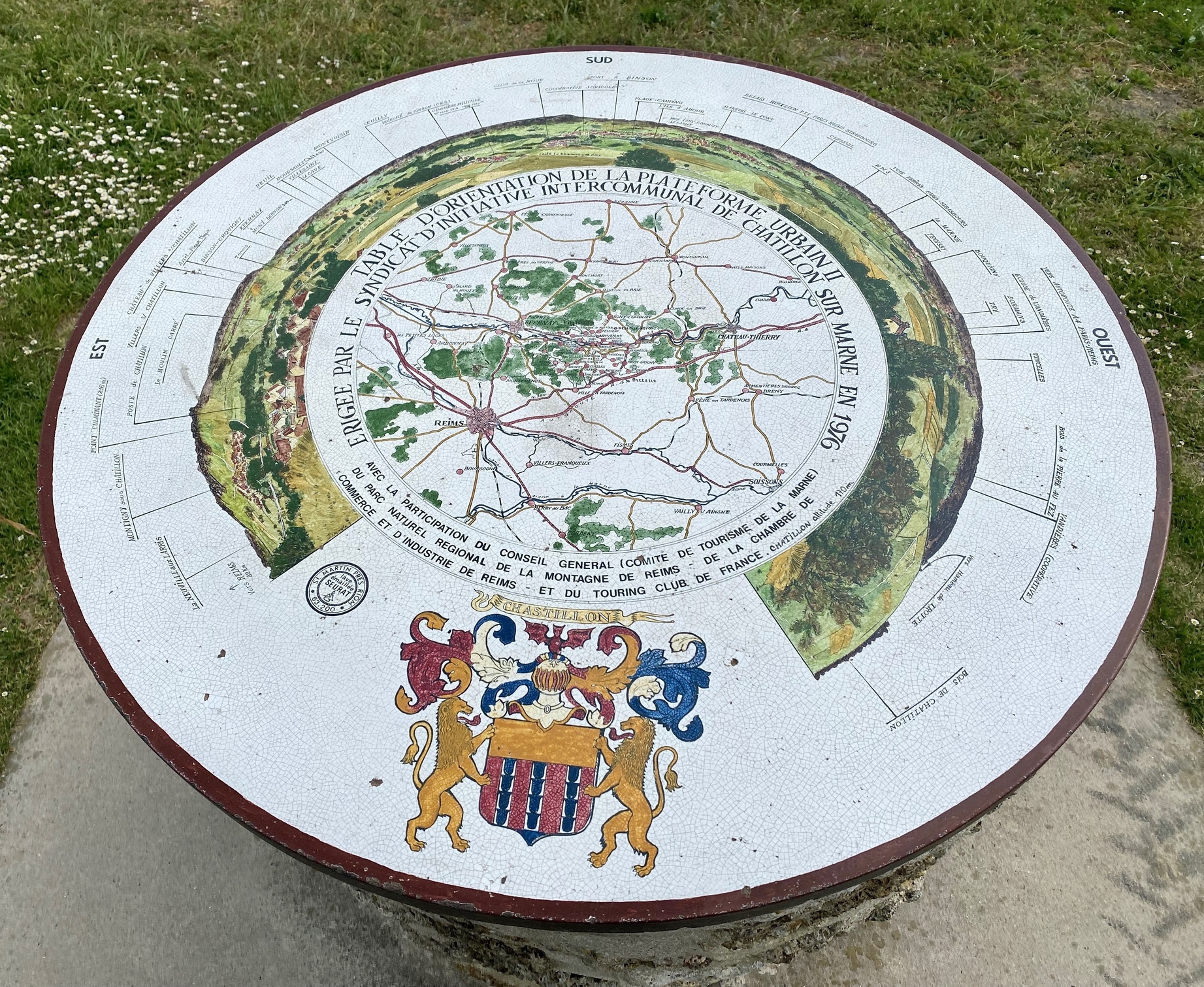
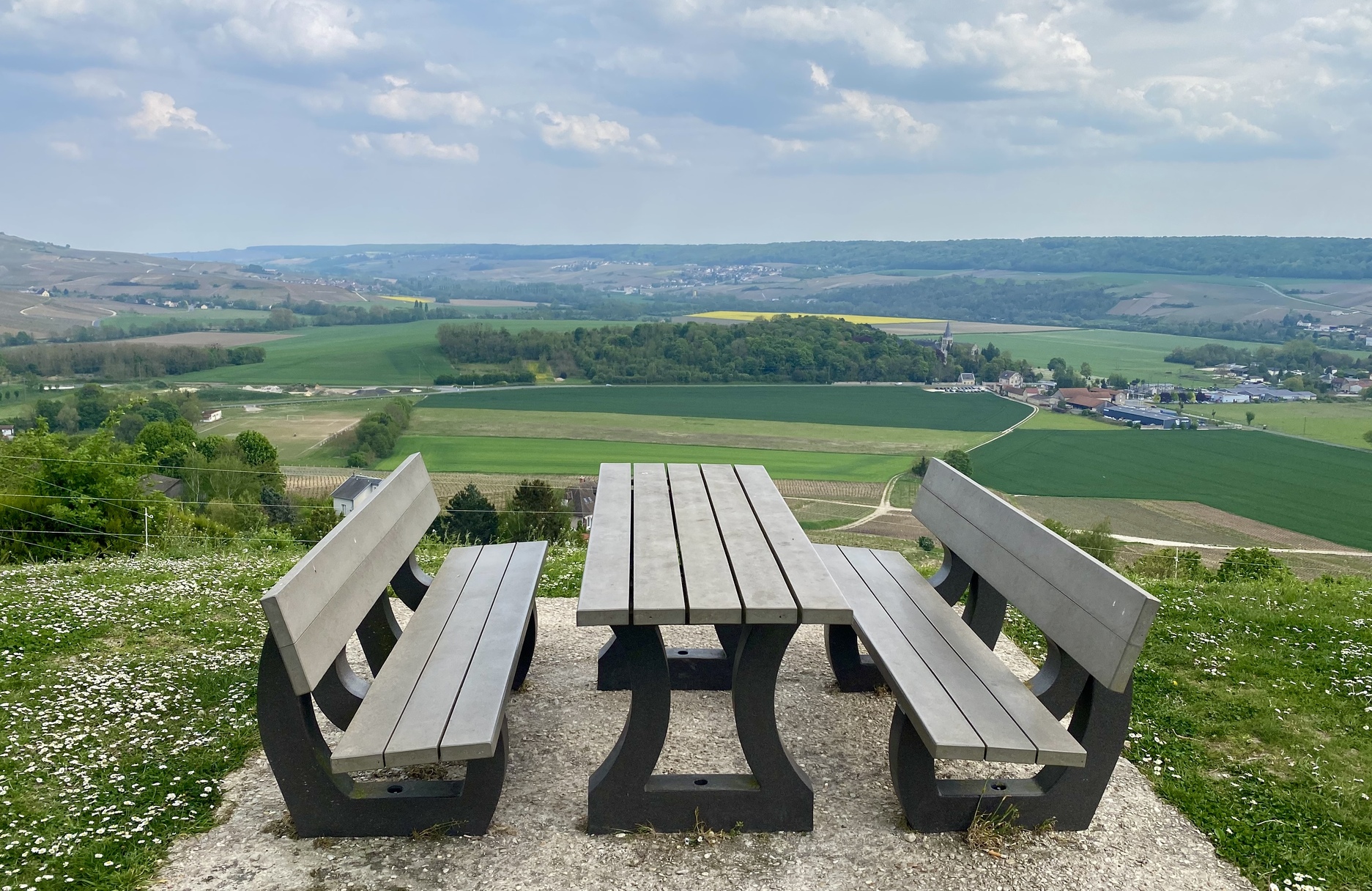
Its location is highly symbolic: the statue stands on the promontory of the former medieval castle, of which today only the foundations, the base of the donjon, and traces of the defensive structures integrated into the panoramic area remain. From this vantage point it dominates the entire Vallée de la Marne and is visible from numerous surrounding villages. Near the belvedere there is an orientation table that allows visitors to identify more than twenty villages, making this site one of the most spectacular geographic observation points in western Champagne.
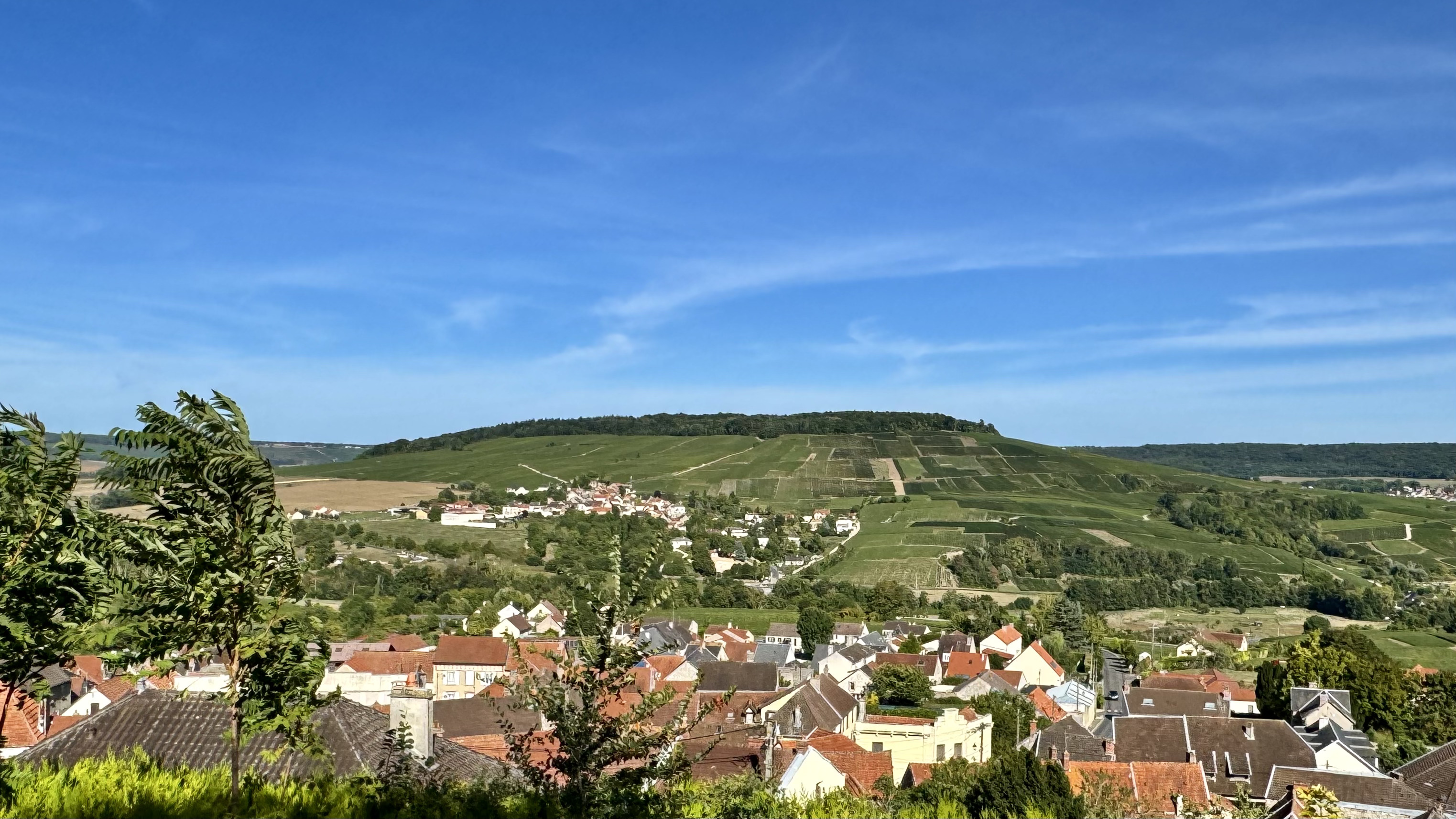
Villages visible from the viewpoint From the panoramic point near the statue, the gaze follows the fluvial corridor of the Marne and the vine-covered hills that shape the landscape of the Vallée. Among the visible villages are Vandières, Cuisles, Baslieux-sous-Châtillon, Binson-et-Orquigny, Troissy, Œuilly, Boursault, Mareuil-le-Port, together with other villages scattered along the valley around Châtillon.
This panorama allows a direct reading of the Champenois territorial structure: the fluvial valley floor as a historic axis of communication, the man-shaped vineyard slopes, and the limestone ridges that define the geological configuration of the region.
Neighboring wine villages and cellars
The production basin directly connected to Châtillon-sur-Marne
Alongside the panoramic dimension, a more concrete and operational reading of the territory emerges: that of the immediately adjacent municipalities, which share with Châtillon-sur-Marne geomorphological continuity, vineyard exposures, and agricultural dynamics. It is within this close-knit area that the most immediate production network of the western sector of the Vallée de la Marne is concentrated.
Cuisles
A village located on the western heights of the Vallée de la Marne, characterized by soils with a strong mineral component. An independent municipality since 1 March 2006, it is home to Champagne Moussé, Champagne Emilien Fresne, Champagne Sébastien Pascal (Château de Cuisles), Champagne André Heucq...
Baslieux-sous-Châtillon
A municipality directly adjacent to the Châtillon hill, positioned on the vineyard slope that rises from the valley floor toward the plateau. Champagne Eric Taillet, Champagne Liébart-Régnier, Champagne Franck Pascal, Champagne Rouillère & Fils operate here...
Vandières
A village on the fluvial valley floor, influenced by the Marne microclimate and historically linked to transport and trade activities. It hosts Champagne Daniel Moreau, Famille Delouvin, Champagne Denis Salomon, Champagne Nowack...
In its balance between historical memory, landscape interpretation, and an active winegrowing network, Châtillon-sur-Marne represents one of the most complete syntheses of western Champenois identity.
Tiziana Mirabella
🔗 Discover Châtillon-sur-Marne, its villages and wineries with our Champagne Chez Moi Tours